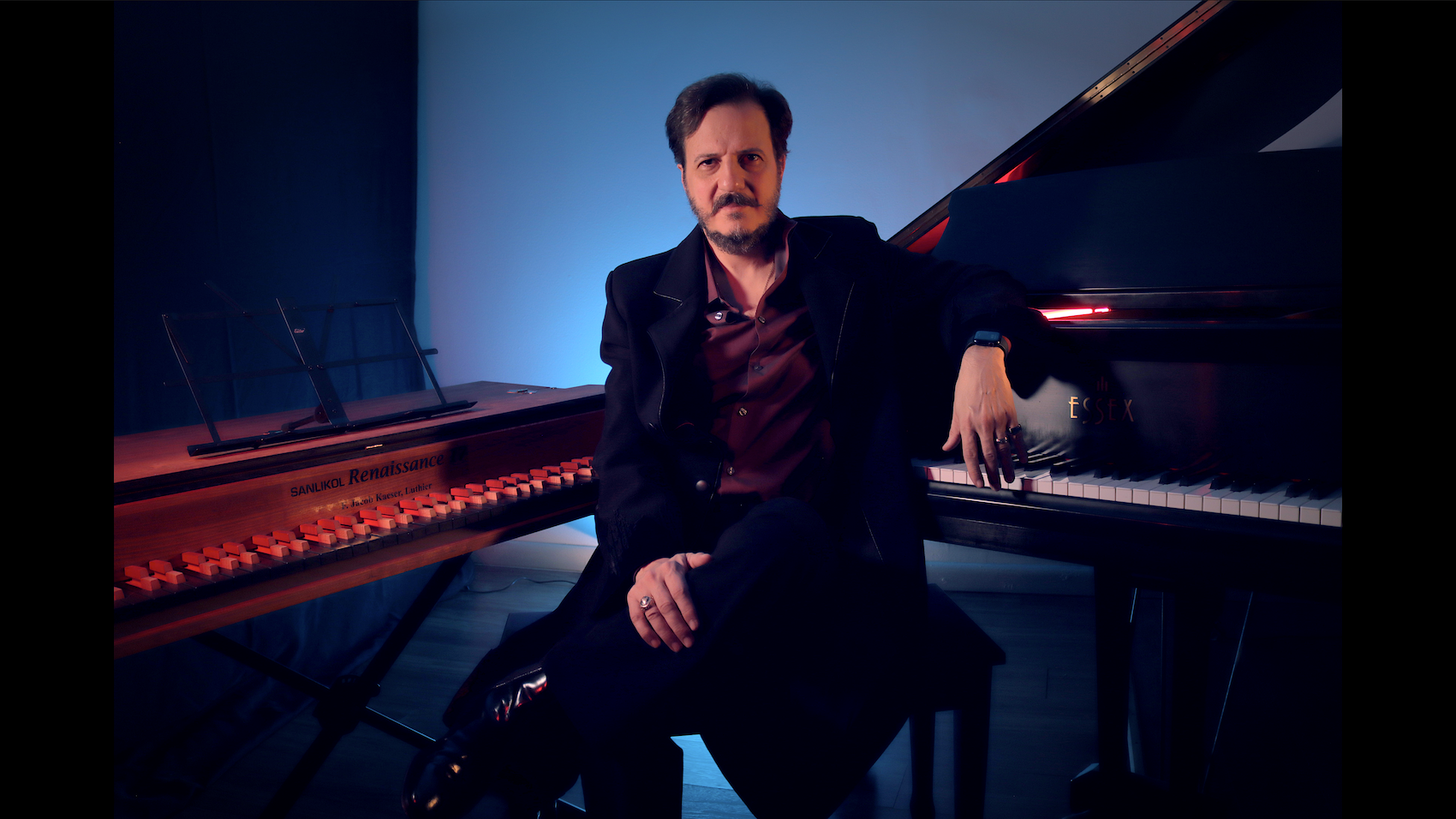
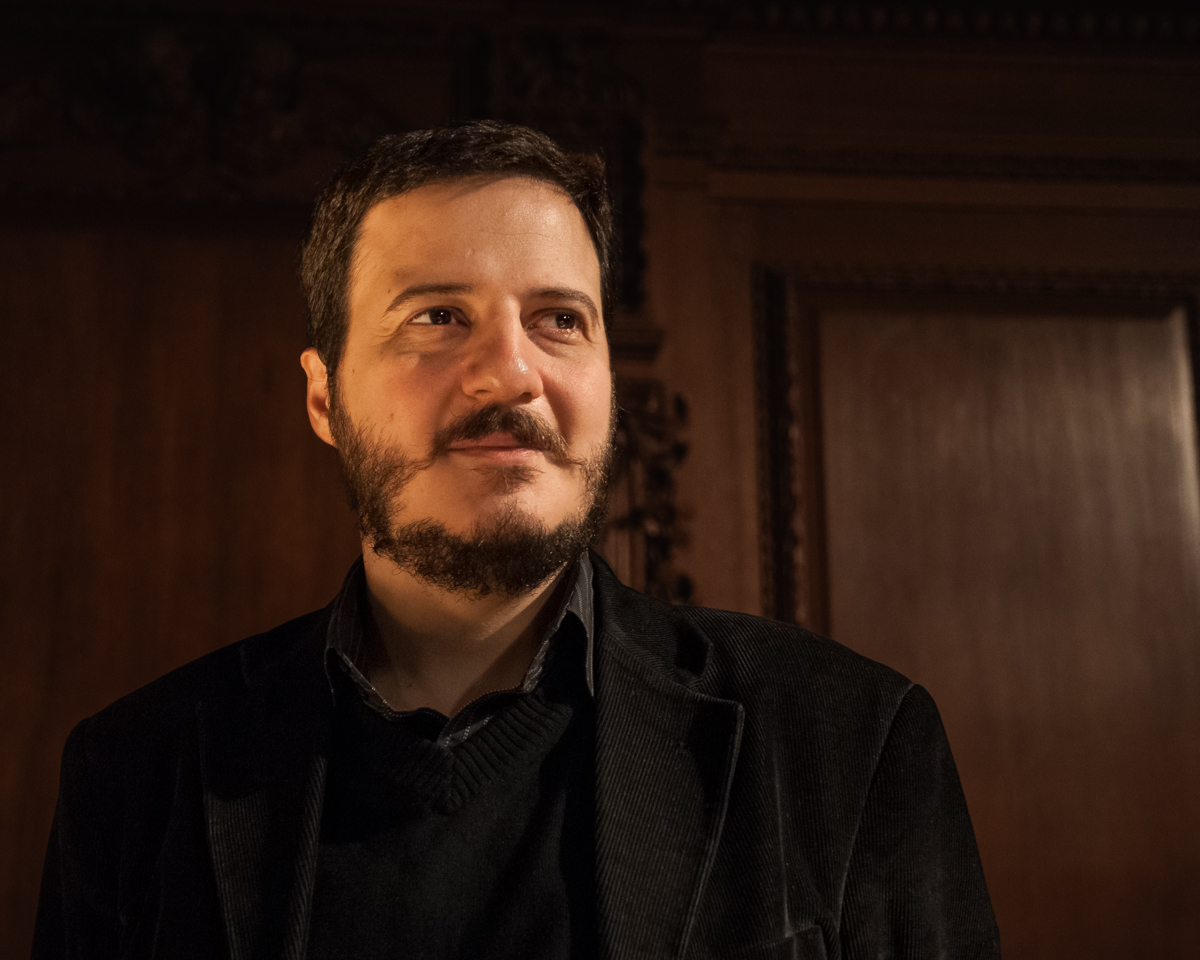
Mehmet Ali Sanlıkol (b. 1974, Istanbul) is a Grammy nominated Turkish-American composer, performer, and scholar based in Boston since 1993. His work moves across contemporary concert music, jazz composition and improvisation, and Ottoman/Turkish music traditions, alongside research and practice-based scholarship as well as instrument innovation. He is a full-time faculty member at the New England Conservatory, where he also serves as Director of the Intercultural Institute.
Across these fields, Sanlıkol’s work is unified by a clear governing principle: musical traditions are not stylistic resources to be blended or referenced superficially, but complete systems with internal conventions, histories, and responsibilities that shape how music is made. His composing, performing, scholarship, and innovations proceed from sustained immersion in those systems, allowing different traditions to interact only after they have been fully learned from the inside.
Composer
Composition is the central axis of Sanlıkol’s creative life. He was trained initially as a classical pianist by his mother, Fethiye Sanlıkol, developing an early grounding in notation, and large-scale structure. Jazz entered his musical life as a teenager and quickly became central, leading him to Berklee College of Music on scholarship, where he studied jazz composition with Herb Pomeroy and Ken Pullig. Further studies with George Russell, Bob Brookmeyer, and Lee Hyla sharpened his focus on orchestration and systems-level thinking. He completed the Doctor of Musical Arts degree in Composition in 2004.
Rather than approaching Ottoman/Turkish materials as coloristic and exotic elements within Western forms, Sanlıkol committed to learning their internal musical logic, particularly the modal system of makam as well as the complex rhythmic cycles of the usul system.
Sanlıkol’s large-scale concert works include Harabat / The Intoxicated (2015), commissioned by Carnegie Hall and the American Composers Orchestra and premiered at Zankel Hall with Sanlıkol as vocalist and oud soloist; A Gentleman of Istanbul: Symphony for Strings, Percussion, Piano, Oud, Ney & Tenor (2018), commissioned by A Far Cry; and Symphonia Phrygia: a liturgical drama – Symphony No. 1 (2004). His choral and vocal-orchestral works include The Triumph (2024), recorded by Blue Heron and DÜNYA; Devran (2017); Mukabele (2014); Şu Yalan Dünya (2015); and Çayda Çıra (1998).
Parallel to his concert music, Sanlıkol has composed an extensive body of jazz works for large ensemble, small group, and piano trio. His jazz orchestra catalog includes Times of the Turtledove (2022), A Capoeira Turca (Baia Havası) (2022), The Turkish 2nd Line / New Orleans Çiftetellisi (2015), and the three-movement “Abraham” Suite (2021), alongside concert-length works such as The Rise Up: Stories of Strife, Struggle and Inspiration(2019) and Echoes from a Forgotten Past (2025). Earlier jazz orchestra works include What’s Next?, N.O.H.A., and On the Edge of the Extreme Possible.
Alongside these works, Sanlıkol has developed what he terms a coffeehouse opera — a unique music drama scaled to intimate performance settings while engaging historically and socially layered narratives. Othello in the Seraglio: The Tragedy of Sümbül the Black Eunuch (2015), is a two-act coffeehouse opera for singers, chamber ensemble featuring European period instruments and Turkish instruments, and a storyteller, with a script by Robert Labaree. Drawing on Shakespeare, Giraldi, and Ottoman historical sources, the work has received more than twenty performances since its premiere and has been adapted into a feature-length film now streaming on Tubi. Another piece entitled Karagöz Orient Ekspresinde (Karagöz on the Orient Express) (2020) does not involve costumes and staging, and it is a forty-five-minute musical comedy for tenor and jazz piano trio with orchestra.
His commitment to classical Ottoman/Turkish makam also led to the development of polyphonic makam, a compositional approach that preserves the internal behavior of makam — including microtonal inflection, melodic hierarchy, and directional motion — while enabling counterpoint, harmonic motion, and extended formal structures. Works composed using these methods include Kürdilihicazkar Kanon, Merhaba, Sultaniyegah Fantezi, and Rast Fantezi for Mehter–Jazz hybrid orchestra.
Scholar
Sanlıkol’s scholarly work grows directly out of his creative practice, grounded in the belief that musical traditions must be internalized and understood historically if they are not to be exoticized. His research focuses on Ottoman/Turkish music, particularly questions of notation, performance practice, theory, pedagogy, institutional organization, and reform.
His first book, The Musician Mehters (2011), examines the organization and musical practices of the so-called ‘Ottoman Janissary bands’ and was published in English by The ISIS Press and in Turkish as Çalıcı Mehterler by Yapı Kredi Yayınları. His second book, Reform, Notation and Ottoman Music in Early 19th-Century Istanbul: EUTERPE, was published by Routledge in 2023.
He has presented research at conferences including the Society for Ethnomusicology and the International Conference on Analytical Approaches to World Music, served as a Fellow at Harvard University’s Center for Middle Eastern Studies from 2013 to 2015, and is Director of the Intercultural Institute at the New England Conservatory.
Sanlıkol is also the founder and president of DÜNYA, a Boston-based musicians’ collective and record label through which he has produced and curated a wide range of recordings and large-scale intercultural projects. And he is the project director and curator of Nilüfer Municipality Dr. Hüseyin Parkan Sanlıkol Musical Instruments Museum.
Performer
As a performer, Sanlıkol brings these ideas into the body, working as a singer and multi-instrumentalist playing instruments such as the piano, oud, zurna, and ney. He has performed internationally in contexts ranging from jazz clubs and festivals to concert halls and interdisciplinary productions, collaborating with artists including Dave Liebman, Bob Brookmeyer, Billy Cobham, Antonio Sánchez, Anat Cohen, Tiger Okoshi, Miguel Zenón, John Patitucci, Gil Goldstein, Esperanza Spalding, Okay Temiz, Erkan Oğur, and Birol Yayla.
Performance functions as a testing ground for Sanlıkol’s compositional ideas. A persistent technical obstacle — the inability of the acoustic oud to function reliably in amplified jazz contexts — forced a practical solution, leading him to collaborate with luthier Mac Ritchey on a custom electric oud capable of sustaining volume, articulation, and pitch stability in groove-driven settings. This work culminates in The Electric Oud Man Speaks(forthcoming), a recording project centered on the electric oud and a long-standing ensemble — trumpeter Mark Tipton, saxophonist Edmar Colón, bassist James Heazlewood-Dale, drummer George Lernis.
Sanlıkol is also the inventor of the SANLIKOL Renaissance 17, a digital microtonal keyboard with seventeen keys per octave (Patent 12,334,044), developed with support from a Live Arts Boston grant. Designed to perform makam with all of its microtonal complexities intact in both notated and improvisational contexts, the instrument has become integral to his later compositions and performances.
As a recording artist and bandleader, his past discography as a primary artist or principal composer includes 7 Shades of Melancholia, Lessons from Nightingales, Turkish Hipster: Tales from Swing to Psychedelic, A Gentleman of Istanbul: Symphony for Strings, Percussion, Piano, Oud, Ney, and Tenor, An Elegant Ritual, The Rise Up: Stories of Strife, Struggle and Inspiration, Resolution, Whatsnext? and A Story of the City: Constantinople, Istanbul.